
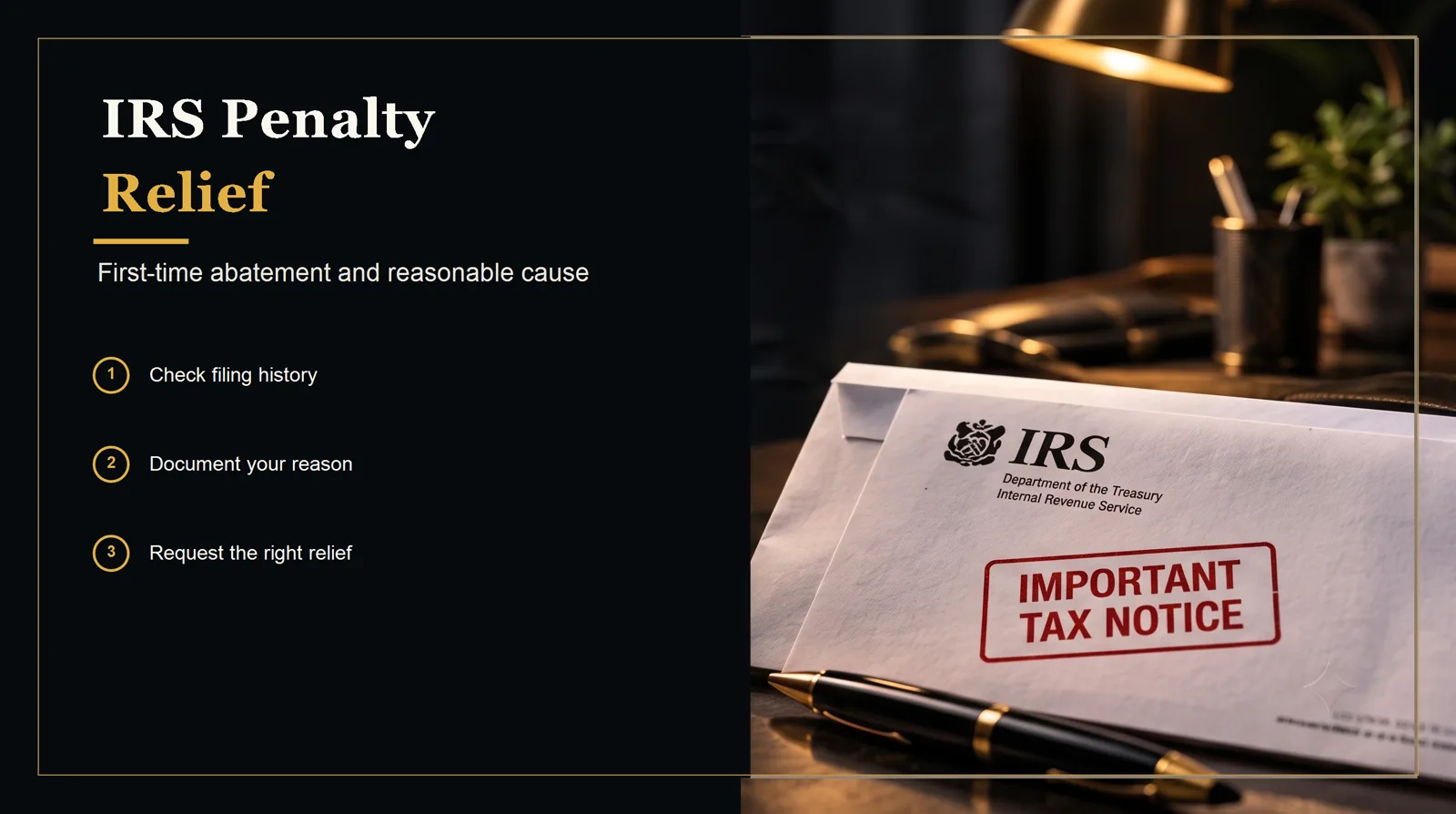
Quick answer: IRS penalty abatement removes penalties the IRS has charged, along with the interest on those penalties. The main routes are first-time abatement, which needs a clean three-year penalty history, all returns filed and the tax paid or on a plan; reasonable cause, such as serious illness or a disaster; statutory exceptions; and IRS error. You can ask by phone, by letter or on Form 843.
On many IRS bills, a large part of the balance is not tax at all. It is penalties, plus the interest charged on those penalties. Unlike the tax itself, penalties can often be removed. The IRS calls this penalty abatement, and it grants it far more often than most taxpayers expect, provided the request is made on time, on the right grounds and with the right proof.
Key Takeaways
- The failure-to-file penalty is 5% a month up to 25%; the failure-to-pay penalty is 0.5% a month up to 25%.
- First-time abatement requires no penalties in the three prior years, all returns filed, and the tax paid or on a payment plan.
- A reasonable cause request must link a specific event to the missed deadline, with documents.
- Relying on a preparer to file on time is generally not reasonable cause.
- Penalties you have already paid can be refunded while the claim period is open.
What Is IRS Penalty Abatement?
Penalty abatement is the removal of a penalty that the IRS has already charged, or a refund of a penalty you have already paid. It does not reduce the tax you owe. It does reduce the total, and it also removes the interest that built up on the abated penalty.
The Penalties That Can Usually Be Abated
- Failure to file. 5% of the unpaid tax for each month a return is late, up to 25%. This is the most expensive common penalty.
- Failure to pay. 0.5% of the unpaid tax per month, up to 25%. The rate rises to 1% per month after a notice of intent to levy goes unanswered.
- Failure to deposit. 2% to 15% of payroll taxes that an employer deposited late or in the wrong way.
- Accuracy-related penalty. 20% of an underpayment, usually added after an audit or an income-matching notice.
- Late partnership and S corporation returns. A monthly charge for each partner or shareholder, which grows quickly.
- Estimated tax penalty. This one is harder to remove, and relief is limited to narrow situations.
Obviously, those numbers can be frightening. But whether you have a representative help you, or you try to remove the penalties on your own, you have to understand the basics.
The Four Routes to Penalty Relief
1. First-Time Penalty Abatement
First-time abatement is available for penalties that qualify. If they do, you do not have to give a reason for being late. To qualify:
- you did not have IRS penalties applied against you in the three tax years before the penalty year in question,
- you filed every required return, or a valid extension, and
- you paid the tax due or are current on a payment plan.
Penalties that qualify include failure-to-file, failure-to-pay and failure-to-deposit penalties, for individuals and for businesses. It covers one tax period. If you have penalties in several years, it normally removes those in the earliest year only.
2. Abatement based on reasonable cause
Reasonable cause relief is based on your personal facts and circumstances. The question the IRS asks is whether you used ordinary care and prudence but still could not comply. Circumstances the IRS commonly accepts include (but are not limited to):
- serious illness or death of the taxpayer or an immediate family member,
- fire, flood, storm or another disaster,
- inability to obtain necessary records despite real efforts,
- an unavoidable absence, and
- incorrect advice from the IRS or, in some situations, from a tax professional.
A reasonable cause request has to connect the event to the failure. It should explain what happened, when it happened, how it prevented you from filing or paying, and what you did once the problem ended.
3. Abatement based on statutory exceptions
Some relief is written into the law. Examples are combat-zone service, federally declared disaster areas, and penalties caused by erroneous written advice from the IRS. When one of these applies, relief does not depend on the IRS's discretion.
4. Abatement based on IRS error
Penalties are sometimes charged because a payment was posted to the wrong year, a return was recorded as late when it was mailed on time, or a deposit was applied to the wrong period. These are corrections, and proof of timely mailing or payment usually resolves them.
How Circle of Tax Advisors helps: Our Tax Advocacy team reviews your IRS transcripts penalty by penalty, identifies which route applies to each one, and prepares the request with the supporting evidence. Where a request is denied, we take it to the IRS Independent Office of Appeals.
What Usually Does Not Count as Reasonable Cause
Knowing what fails is as useful as knowing what works.
- "I did not have the money." Lack of funds alone does not excuse a late return, and it rarely excuses late payment unless you can show why the funds were unavailable despite careful planning.
- "I did not know I had to file." Ignorance of the law is usually not enough on its own.
- "My accountant filed late." The Supreme Court has held that the duty to file on time belongs to the taxpayer and cannot be delegated. Relying on a preparer to meet a deadline is generally not reasonable cause. Relying on a professional's substantive advice about a complex issue can be.
- "I forgot" or "I was busy." Oversight is not ordinary care.
Requests fail most often because they describe a hard time in general terms. A request that gives dates, documents and a clear link to the missed deadline is treated very differently.
How to Request Penalty Abatement
- Get your account transcripts. They show each penalty, its amount and the date it was charged. They also show your three-year history for first-time abatement.
- Become compliant. File any missing returns. Pay the tax or set up a payment plan. The IRS seldom grants relief to an account with open filing requirements.
- Choose the grounds for each penalty. Use first-time abatement where you qualify and reasonable cause where you do not. Sometimes you may have more than one reason that applies to different penalties.
- Make the request. Smaller, simpler requests can often be made by phone using the number on the notice. Written requests are made by letter or on Form 843, Claim for Refund and Request for Abatement.
- Attach proof. Hospital records, death certificates, insurance claims, disaster declarations and correspondence all help. Keep copies of everything.
- Appeal if you are denied. A denial letter explains your appeal rights. Many abatements are granted at the appeals stage.
Order Matters When You Have Several Bad Years
First-time abatement can only be used when the prior three years are clean. If you have penalties in 2021, 2022 and 2023, the waiver fits 2021. The later years need a reasonable cause argument, because each of them now has a penalty in its look-back period.
For that reason, it is usually better to argue reasonable cause first wherever the facts support it, and keep the first-time waiver for the year that has no other argument. Using the waiver on a small penalty and losing it for a large one is a common and avoidable mistake.
Can I Get a Refund of Penalties I Already Paid?
Yes. Abatement is not limited to unpaid balances. You can claim a refund of a penalty you have paid, generally within three years from the date the return was filed or two years from the date the penalty was paid, whichever is later. Many taxpayers paid penalties without knowing they qualified for first-time abatement, and that money can still be recovered while the period is open.
Penalty Abatement for Businesses
Employers face some of the steepest penalties in the tax code. Late payroll tax deposits are penalized on a sliding scale, and late Forms 941 add failure-to-file and failure-to-pay penalties on top. Partnerships and S corporations are charged per owner, per month, for a late return, even when no tax is due.
Business penalties are often strong candidates for relief. First-time abatement applies to them, and small partnerships may qualify for a separate long-standing exception when all partners reported their income on time.
Accuracy Penalties After an Audit
The 20% accuracy-related penalty follows different rules. First-time abatement does not apply. The defense is that you had reasonable cause and acted in good faith, for example by giving complete information to a qualified preparer and relying on the advice you received. This argument is best made during the audit itself. Our Tax Audit Defense team raises it before the penalty is assessed.
Is the penalty worth fighting? Often yes. On a $20,000 tax balance, failure-to-file and failure-to-pay penalties can approach $9,500 before interest. We tell you at the start what the potential saving is and what our work will cost, so that the fix never costs more than the problem. Book a confidential conference.
Penalty Relief Routes Compared
| Route | Who qualifies | What you need |
|---|---|---|
| First-time abatement | Clean three-year penalty history, with filing and payment compliance | Transcripts showing the history; request by phone or in writing |
| Reasonable cause | Events beyond your control despite ordinary care | Dates, documents and an explanation linking the event to the failure |
| Statutory exception | Combat zone service, declared disasters, erroneous written IRS advice | Proof that the exception applies |
| IRS error | Payments or filings recorded incorrectly | Proof of timely filing or payment |
Checklist: What to Do First
- List penalties by tax period.
- Check filing and payment compliance.
- Document reasonable cause where relevant.
- Request relief through the appropriate process.
Find Out What Your Penalties Should Be
Send us your latest IRS notice and we will tell you which penalties look removable. Call Circle of Tax Advisors at 517-336-7824 or book a confidential conference.